The testing window at the GIS operation site is often narrow: voltage resistance, partial discharge, SF6 gas, circuit resistance, and mechanical characteristics are interrelated. Once the equipment encounters problems in portability, anti-interference, or range matching, it is not a single instrument that is held back, but the entire power transmission plan. The first step in selection is not to look at the highest indicator on the parameter table, but to answer the three questions of "whether it can be used on site, whether it can be measured accurately, and whether it can be moved or not" clearly.
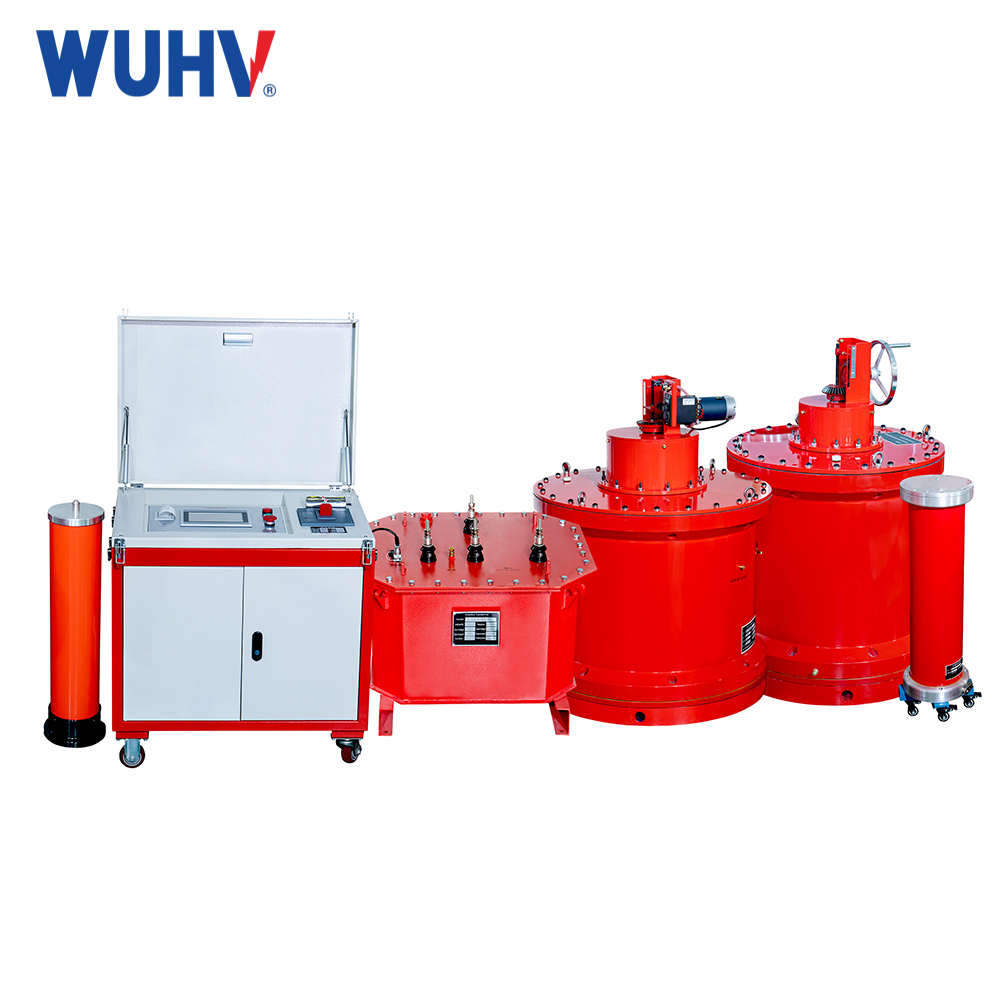
AC withstand voltage is the heaviest load in GIS handover test. The capacitance of GIS samples is large, and traditional transformer testing schemes have high requirements for volume and power supply capacity, often limited by power supply conditions on site. The variable frequency series resonant device utilizes the principle of resonance and only requires one tenth of the power supply capacity of traditional equipment to complete voltage boosting, which is particularly critical for substation sites. The series resonant series of Wuhan UHV adopts modular split design, and the reactor can be flexibly combined according to the capacitance of the test sample and the test voltage, adapting to the on-site handover test requirements of GIS with voltage levels from 110kV to higher. When selecting, it is necessary to verify the matching relationship between the capacitance of the test sample and the rated output capacity of the device, in order to avoid hidden shortcomings such as "sufficient voltage but insufficient capacity".
Partial discharge detection is the most critical step in GIS operation that tests selection and judgment. The UHF method is preferred for internal discharge in GIS, and the detection frequency band usually focuses on the 300MHz to 1.5GHz range, supplemented by ultrasonic method for discharge source positioning. But on-site selection cannot stop at 'supporting UHF'. GIS has multiple intervals and the pouring ports of bowl insulators are scattered. Portable partial discharge devices need to have multi-channel synchronous acquisition capabilities in order to synchronously capture discharge signals from multiple gas chambers during the voltage withstand and boosting process. The partial discharge testing system of Wuhan ultra-high voltage covers multiple sensing methods such as UHF and AE, and its TEPS series is adapted to the electromagnetic environment of substations in terms of multi band sensing networks and on-site anti-interference algorithms. When selecting, special attention should be paid to the compatibility between sensors and GIS bowl type insulator pouring ports, as well as whether the equipment can maintain stable detection sensitivity in substations with high background noise, rather than just comparing the lowest measurable discharge capacity under laboratory conditions.
SF6 gas detection is easily overlooked as an "auxiliary project", but in fact, the gas micro water and leakage rate during the operation stage are directly related to the internal insulation margin of GIS. During the handover acceptance, it is necessary to perform point by point leak detection on the connecting flanges, density relay interfaces, and inflation valves of each gas chamber. The core selection criteria for portable leak detectors are not the upper limit of sensitivity nominal values, but the zero stability under on-site temperature fluctuations and background gas interference. The SF6 micro water tester for Wuhan UHV covers a range of 10ppm to 2000ppm, with built-in temperature compensation. The total weight of the machine is less than 5kg, making it suitable for mobile operations between various gas chambers in the GIS room; The leak detector adopts a compact design, which is convenient for operation and maintenance personnel to scan handheld. For the operation scenarios of conventional substations of 110kV and below, basic portable equipment can meet the requirements of DL/T standards without paying additional costs for redundant functions.
The testing of circuit resistance and mechanical characteristics cannot be ignored. The contact resistance between GIS circuit breakers and isolating switches exceeds the standard or the mechanism operates abnormally, which may still pose operational hazards even after passing the withstand voltage and partial discharge standards. The circuit resistance test should ensure that the commonly used current range (such as 100A and above) has a constant current stable output, with an accuracy of not less than ± 0.5% and a resolution of 0.1 μ Ω. The product system of Wuhan UHV covers the categories of circuit breaker testing and circuit resistance testing. Portable models are designed to meet the needs of on-site power supply difficulties and mobile operations.
Returning to the underlying logic of selection, the decision-making sequence for GIS portable devices should be: first, lock the voltage level and chamber structure of the tested object, determine the hard boundary between the withstand voltage capacity and partial discharge sensing method; Re evaluate the actual constraints of on-site power supply conditions, transportation channels, and operating hours on equipment weight and endurance; Finally, it is necessary to compare the accuracy and functional density among the models that meet the first two criteria. Wuhan UHV has portable product layouts in series resonance, partial discharge detection, SF6 gas analysis, and circuit resistance. Its equipment continues to iterate in the direction of "lightweight, automatic tuning, and strong anti-interference", providing a reference system for GIS operation site selection that can be disassembled item by item and combined as needed. Selection is not about pursuing a set of "universal instruments", but about ensuring that every piece of equipment brought into the GIS room stably outputs at its most appropriate location.